Born, as I was, eight years after my grandfather’s retirement I never actually saw Charles Nurser (1874 - 1967) building boats. In fact, although he supervised the lay up of Barlow’s new boats almost to the end (illness prevented him from checking Raymond) I was too young to appreciate his work. Great Uncle Frank had died in 1952 so was remote from my young life. I was, however, aware of Grandad’s reputation. The Birmingham Post and Mail in April 1955 featured him in his home workshop ‘The Stables’ painting stools for his grandchildren. Whilst Frank was the doyen of canal boat painters, both brothers could, I think, turn their hands to most aspects of boat building and painting. Grandad once told me his speciality was cabin joinery. Fortunately I took O level Woodwork and a theoretical project was required. My father suggested ‘building a narrow boat’. In 1965, two years before his death, Grandad told me, in broad terms, how to do it. No plans or blue prints of course. It just came out of a lifetime’s experience.
My father had fond memories of living ‘down the wharf’. By 1881 his parents were resident in ‘Fairview’ the end house of the row nearest the railway bridge. He remembered looking out of his bedroom window at the boatman’s strike of 1923. Grandad also bred chickens (as did both Frank and Walter). His business card proclaims him as ‘Breeder of Pure Bred Light Sussex and Anconas: Eggs and Chicks in season’. I was told that the workers’ ‘Christmas Box’ used to be a chicken. Tastes in humour change. When the yard ‘lad’ arrived to collect his, it was still running around the pen and he had to chase it and wring its neck. Equally ‘humorous’ was the joke played by the keeper of the relatively new pump engine installed to move water to the top of the lock flight. As a small boy, Grandad and his friends would bathe in the pool of warm water that resulted from pumping. At least, they did until the keeper released tar in to the water.
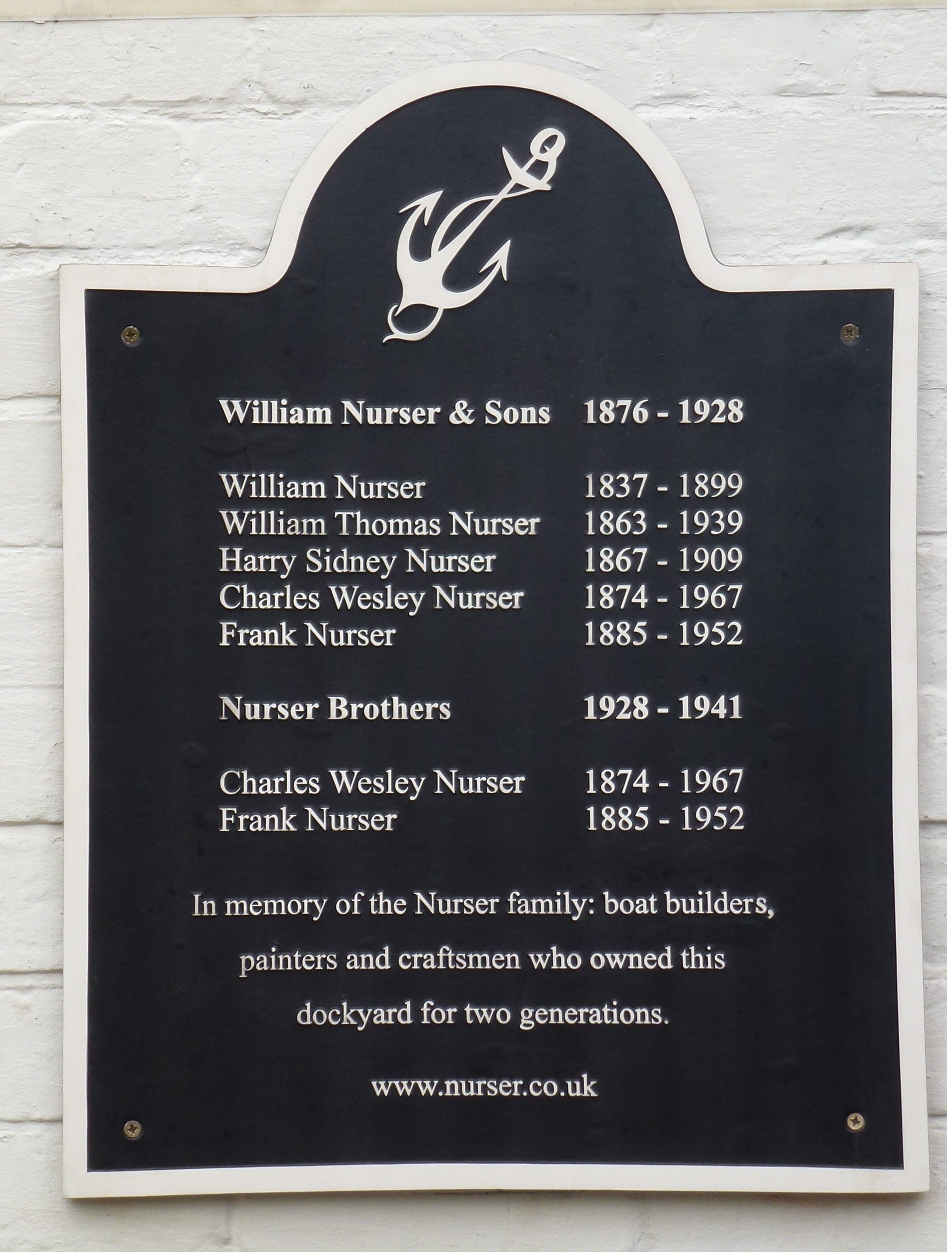
The Nurser family dominated the London Road houses near the Wharf. The Champion Inn had passed to Grandad’s father, William when he bought the Dock in 1875. In 1901 his second son Harry Sidney moved in to a nearby house with his new wife, daughter of Canal Carrier Emmanuel Smith, later of Brentford. The Smith family also lived in one of the houses on the London Road. Harry Sidney, together with his elder brother William Thomas, inherited the business on the death of their father in 1899. The 1901 census lists Charles and Frank as boat builder and boat painter respectively, still living at home with their widowed mother and in the employ of their elder brothers. The business continued to trade as William Nurser and Sons. Harry Sidney died in 1909. Although William Thomas, also living nearby, carried on, increasingly poor health caused him to sell up in 1929. The business was put out to tender and it was by no means certain that it would remain with the Nurser family. Indeed I remember my father telling me that at one time a move to Tring seemed likely. No doubt this was before Charles and Frank were successful in their bid to continue the business, changing the name to Nurser Brothers. William finally died in 1939. Charles retired in 1941 but agreed with Captain Patterson, Managing Director of the new owners, Barlows, that he would continue to supervise the lay up of their new boats. Frank remained as Manager until his death. It was he therefore who so impressed the young Tom Rolt on his legendary travels.
Although it was William Snr and his four sons: William Thomas, Harry Sidney, Charles Wesley and Frank who were central to the business, other brothers were also involved in peripheral ways. Walter, who lived in Champion House (the old public house) was a coal merchant and gardener for Mary Bucknill at Ivy House, the big house behind the London Road. According to the Nurser Brothers’ Company ledgers kept by Frank, regular payments were made to Walter for stabling and garaging. Another brother, Hedley, was landlord of The Old Ship Inn which was situated on the dock side of the London Road, under the LNWR railway bridge. An advertisement in The Midland Daily Telegraph for 7th July 1900 names H. Nurser as Proprietor. Apparently he occasionally helped out with the Company books. Almost opposite The Ship Inn was Frank’s home: The Pebbles, situated at the bottom of the old London Road. In 1930 Charles relocated to the High Street in the village. He and his wife moved in with his recently bereaved wife’s aunt
William Nurser Snr produced a large family, most of whom survived to adulthood. His first wife, Mary Manning, died within a year of marriage, his second, Clara Deakin White, bore a total of nine boys and two girls. His third, Mary Anne Wykes, a boy and a girl. The boy was Frank so, in fact, Charles and he were half brothers. They were, by all accounts rather different in character. Frank was outgoing and confident. He was a capable cricketer, playing for the local team. He named his daughter Grace. Grace Road was the home of his favourite cricket team: Leicestershire. A narrow boat of the same name followed. Not only was he the master painter, but he also managed the accounts. Charles was quiet and self effacing. When ‘Painted Boats’ was filmed he was nowhere to be seen whereas Frank was interested and involved. He rather enjoyed the celebrity status gained when Tom Rolt publicised his work.
Although their father was a member of the Church of England, Charles and his immediately elder brother Walter were staunch Methodists (Charles was christened Charles Wesley). Other brothers were less committed. Perhaps these two gained their faith from their mother, Clara. She was the daughter of Charles White who kept the shop at the Stop Lock. Her Uncle was Alfred Deakin, Prime Minister of Australia 1903-1910. A distinguished man, he wrote a classic reference work on irrigation in India. He refused many titles and honours offered by the Government and even a D.Litt from Oxford University; such refusals were often a characteristic of nonconformism. An unconfirmed story that I heard was that Charles would march the men up from the dockyard to Chapel every Sunday morning. Certainly he and his wife Marion (known as Mary) were long serving Sunday School teachers. It is interesting that Methodism was a faith shared with the Barlow family with whom there were increasingly close business ties. The Champion Inn had been sold to the Wesleyan Society in 1863 and still in its grounds is the corrugated iron hut built as a Boatman’s Mission. It was known variously within the family as ‘the clubhouse ‘ or ‘the tin tabernacle’.
Many of the Nurser family are buried at Braunston; the older generation adjacent to the Church. Frank is buried in the graveyard at the back, as are three of Charles’ children: Edith, Lesley and Stanley. My father Maurice was the only one to survive to old age though Stanley married and had a daughter. William Thomas had 3 boys, the eldest of whom, Alfred Walter died in 1982, I believe, childless. Harry Sidney’s family I am in the process of researching. I am finding it very hard to obtain photographs of either of these elder brothers. If any reader can help I would be most grateful. I can be contacted via my website nurser.co.uk where further information can be found.